Redwood Sorrel

2012-10-12_18-10-15_152

As I was hiking up the mountain for the last time this afternoon, I was hoping to find some creatures to draw. The weather today however, is cold and rainy and the forest is quiet. I can hear a few birds in the canopy, but I don’t see them, and I’m not seeing even banana slugs out to play. As I crossed across Merrill Meadow I saw scratching tracks left by a Mountain Lion. Alex described them to me a few days ago, he has been keeping notes on them up in the meadow. “Here… kitty, kitty, kitty…”

Now, I’m in full rain gear and laying on a foam mat, protecting the sketchbook within a plastic bag as I draw. Large drops of water are falling on the plastic bag with loud plops. It’s quite a change considering we started the walk, with me sketching the view into the forest from about ten feet from here and about 50° warmer.

On the forest floor, growing up from the redwood duff, is redwood sorrel. These little plants are among the few with their leaves still open, most of the sorrel has folded-up in the rain, but these ones are still only a little wet under the shelter from a particularly large tree. Redwood sorrel looks similar to clover, and is edible. I’ve seen friends make salads out of it, even though it tastes a bit tangy.

UC Santa Cruz, Natural Reserve
10/11/12

Fern Sex

2012-10-10_18-40-33_630

So, we are talking about plant reproduction already a bit on this nature walk, and I see little black dots on the undersides of some of the fern fronds. It reminds me that a few weeks ago, a fern frond kept poking Arthur in the back of the head as we sat in an outdoor coffee shop. He noticed the black dots and didn't know what they were. I pulled the wood fern from the previous drawing (Dryopteris sp.) under a dissecting microscope, and here's what I saw on it's underside…

The dots themselves are each called a sorus, and that's about all I could see with just my eyes. With magnification though, they look like little grey rounded fortune cookies with golden, brownish spheres spilling out of them which are the sporangium. I also see little white dots on the leaves, they are very tiny and those are the actual spores.  Fern spores are haploid, and fern reproduction is not entirely linear, so we'll leave it at that.

(Unless, you're Really curious… in which case I found a reasonably good diagram of fern reproduction on the University of Maryland's website: http://www.life.umd.edu/cbmg/faculty/acaines/bsci124/AlgaeSpore.html)

UC Santa Cruz, Natural Reserve/Natural History Museum
10/11/12

Ferns

2012-10-10_17-27-44_437

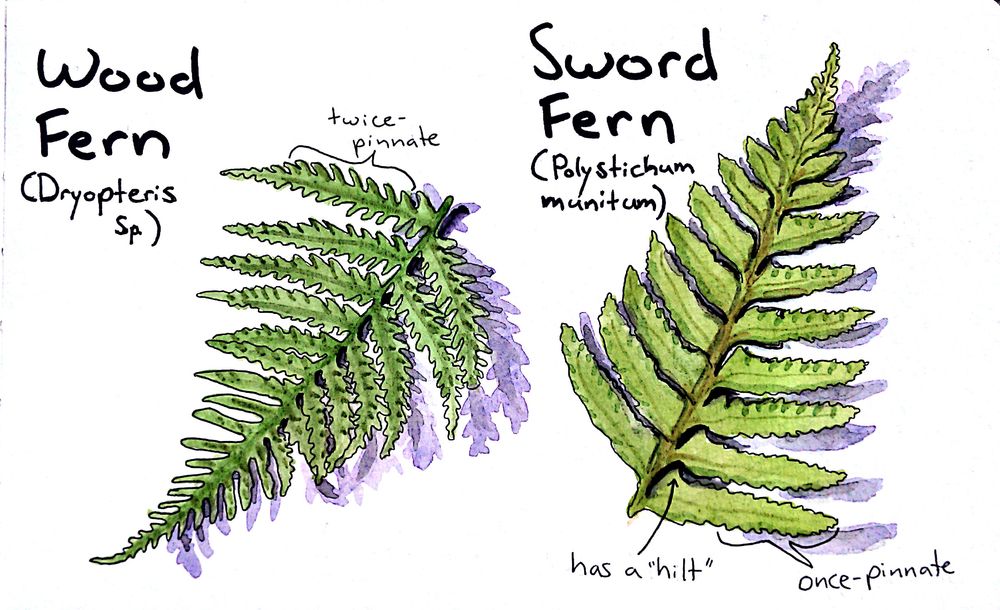
Ferns are predominant in the undergrowth here. From a distance wood ferns looks lighter, almost fluffy because they are twice pinnate. The sword ferns however have a sturdier profile; they form longer, undivided fronds that could look like the blades of swords. They also have an extra notch just at the base of each pinnule that looks like a sword hilt. I wouldn't recommend trying to fence with them though.

UC Santa Cruz, Natural Reserve
10/10/12

Lichens

2012-10-04_11-59-22_031

So, are you Lichen our nature walk? Hehe… Yes, that Is funny.

There's a bizzillion types of lichen in this forest here as you can see here (http://bio.research.ucsc.edu/people/goff/Lichens%20of%20the%20UCSC%20Campus/index.htm). So I'm going to describe what I see, as generally useful distinctions between catagories of lichens, instead of individual species.

I'm seeing leprose lichens on the trunks of trees, it kinda looks like they've been spray painted on, and I'm seeing lots of twigs on the ground with a combination of fruiticose and foliose lichens mixed together on them. The foliose lichens are wavy lobes, that I've heard described as 'leaf-like', and the fruiticose lichens are branching and spindly growing in clumps, mostly draping down from the twigs.

UC Santa Cruz, Natural Reserve
10/5/12

More tree sex

2012-10-04_11-58-21_271

Redwoods, as much as I love them, are not the only tree in the forest. We also have Knobcone Pine’s and Douglas-fir’s. As long as we’re talking about tree sex, let’s look at their cones too. The Douglas-fir cones are three or four times as large as our little redwood cones, and the monstrous Knobcone Pine cones are as large as my fist and kinda hefty. I imagine they would make pretty effective weapons, if I had to defend this forest from Storm Troopers.

UC Santa Cruz, Natural Reserve
10/4/12

Tree Sex

2012-10-03_18-41-48_465

Let’s talk about tree sex! So, it’s neat that Coast Redwoods can clone themselves, but variety is nice. These little cones (about the size of a dime) go from tight green balls to open brown cones as they mature. This green cone gave me quite a surprise. It exploded open while I was drawing it, scattering seeds in a radius of about a meter!

Redwood cones are prolific on the forest floor, and each cone gives us a few dozen seeds. That’s a lot of seeds, and there’s not much space here for more trees… Alex thinks that seed viability isn’t very high, although he says he hasn’t tested that yet, a study done at UC Berkeley agreed and shows that older trees have a higher percentage of viable seeds. Our young forest then is less likely to be reproducing sexually, than a more mature forest.

UC Santa Cruz Natural Reserve
10/3/12

Into the Redwoods

2012-10-02_14-39-19_167

The forest is quite hot today, approximately 95°F, luckily under the dappled share of the redwood trees it feels a bit cooler. The primary tree species here are Coast Redwoods (Sequoia sempervirens). I can see ferns growing in the redwood duff and young trees sprouting from the base of the older ones. This is one type of asexual reproduction. The trees grow in clusters here, called fairy rings, which are clones of each other resulting from the original parent tree being cut down. Most of this forest is secondary growth.

UC Santa Cruz Natural Reserve
10/2/12