
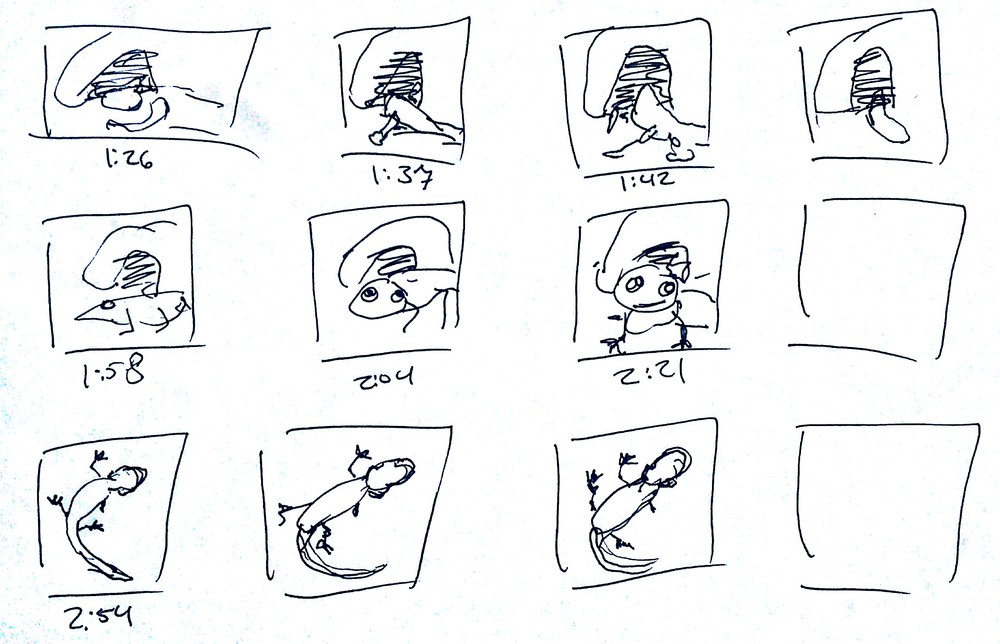
Legolas is still mostly hiding under a rock.
Santa Cruz, CA 2/15/12
Legolas is still mostly hiding under a rock.
Santa Cruz, CA 2/15/12
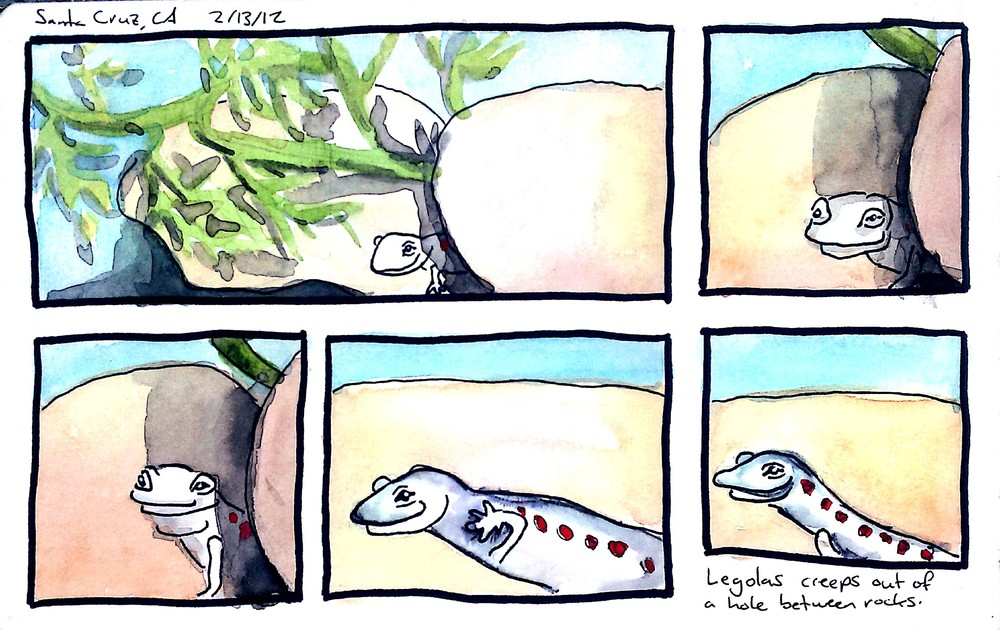
In more cheerful newt news… Legolas our young Paddletail newt (Pachytriton brevipes) is doing well still. He likes hiding in the caves between rocks and comes out when I tempt him with worms.
I regret to inform everyone that the last of our efts has died. We buried Two-Spot yesterday morning. Sorry, no drawing, it was too sad for me. He survived for more than two months, but never ate. Thanks to everyone who expressed their concern for the little guys. I thought everyone would want to know how the little ones fared after our eft-up situation (https://walkaboutem.com/my-eft-up-situation).
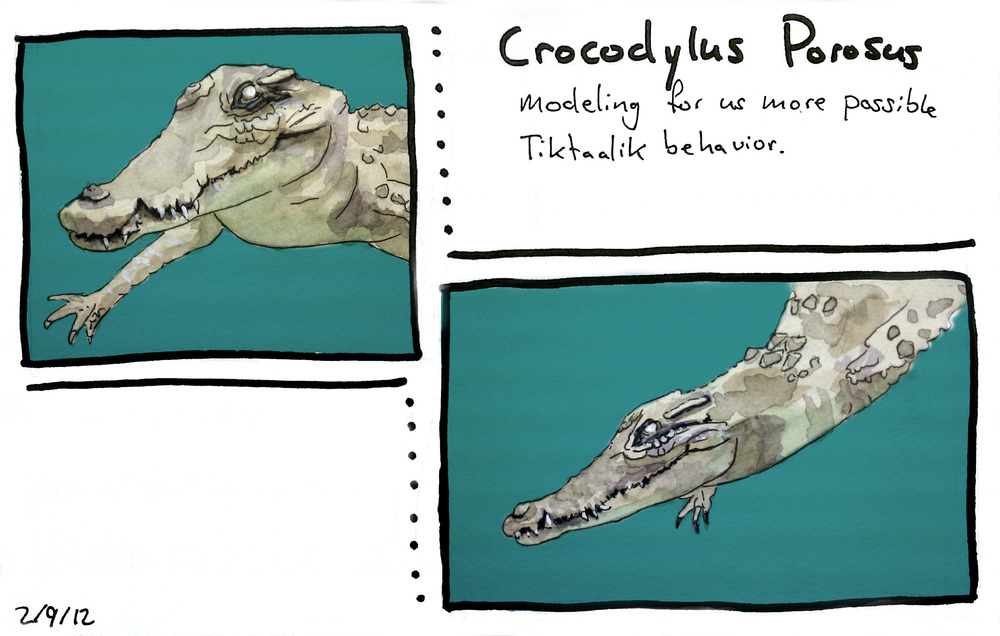
Russell and I spent part of our meeting this week discussing whether or not Tiktaalik would have had a nictitating membrane on its eyes.
Russell says:Now, of course, we’ve found lots of other fossils that bridge the gap between Panderichthys and Ichthyostega. From most basal to most advanced the sequence goes: Lungfish > Eusthenopteron > Panderichthys > Tiktaalik > Elginerpeton > Ventastega/Metaxygnathus > Acanthostega > Ichthyostega. (Of course, all of these taxa except for the lungfish are too late in geological time for this sequence to be a literal, linear genealogy, but they do accurately represent the various anatomical grades that would have led to Ichthyostega.) Somewhere along this sequence the nictitating membrane appeared. Lungfish do not possess it, and it’s not likely that Eusthenopteron, with its laterally directed eyes, did either, but from Panderichthys on, these animals tend to have more flattened heads and eyes on top of the skull, more like modern amphibians. This certainly implies that they were spending a significant amount of time with the top of the head exposed to the air. I don’t think there’s any reason that Tiktaalik couldn’t have had a translucent third eyelid."
Therefore, matching the reference images we have of saltwater crocodiles underwater, we've decided to keep Tiktaalik's eyes white (at least underwater). Besides, it looks nice and creepy for our antagonist.
Santa Cruz, CA 2/9/12

On Thursday, I adopted a young Paddletail newt (Pachytriton brevipes) who will be one of my live models for Acanthostega. I named him Legolas because he’s missing his front right leg. I decided not to name him Legless because the legless (lgl) insertional mutation would imply genetic variation and he most likely lost his leg in a fight with another newt. When I brought him home I carefully unloaded him from the back of my bicycle and set him free in the terrarium I set up for him. His first three hours were a blur of motion as he climbed and swam all over exploring his new home. This cartoon was what I could capture from his initial frolicsomeness.
Now, he mostly hides in the nooks between the rocks and only ventures out when I bribe him with yummy worms. So far he is doing well and has eaten twice.Santa Cruz, CA 2/6/12
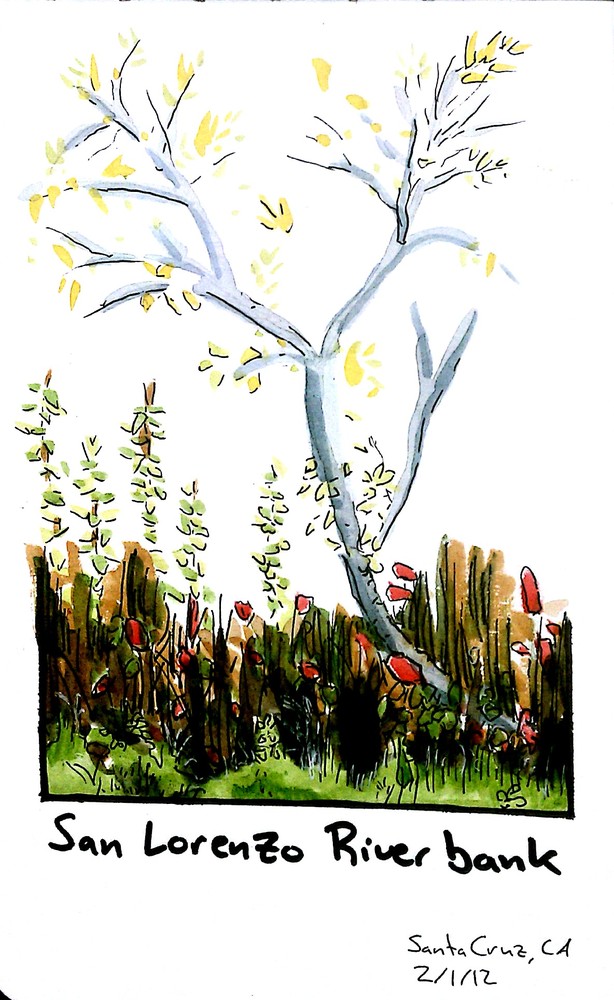
I biked along the San Lorenzo River this afternoon, searching for a good spot to sketch to get a few more reference drawings for building a Devonian riverbed ecosystem. I found a good spot, hopped off my bike and started trampling through the dead grass at the banks. The water in the river was low and there were large sections of drowned re-exposed grass. I saw one spider, then two, then I stopped looking for a good place to lay down (to get the best low angle, from creature perspective) and started looking at my feet. There were millions of chubby, dime sized black spiders. I'm not arachnophobic, but the idea of laying on my stomach in a bed of grass teeming with spiders was too much even for me. Instead, I climbed back up the riverbank and drew this in the remaining daylight.
Just imagine, at the grass at the base of that tree, there are spiders as dense as 20 spiders to the square foot.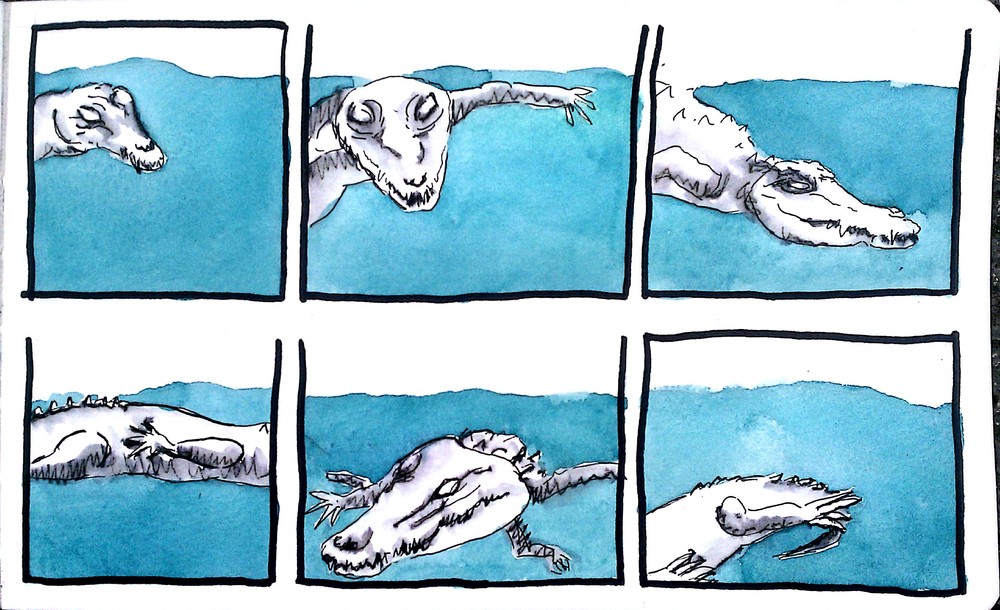
Crocodile (Crocodilus porosus) behavior as a model for Tiktaalik. This entire sequence took place within 23 seconds.
1/30/12
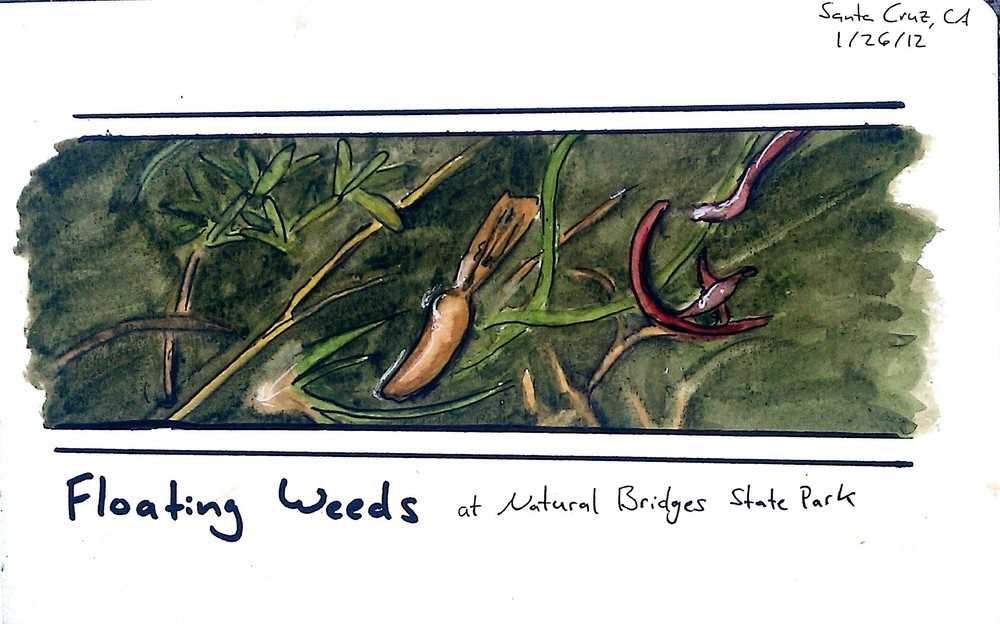
Mmm… Seaweed floats… and bits of drifting grass. River muck can be so colorful. 🙂

Yesterday I biked out to Natural Bridges State Park to join a group of watercolorists. I enjoyed having other artists to sketch with in the brief afternoon sunshine. Im' still collecting sketches to be turned into a Devonian semi-aquatic ecosystem, these are amongst that set.
 Walkabout